2  Git and Github workflow

(This is not meant to be a complete guide to git, but rather a short summary of key commands)

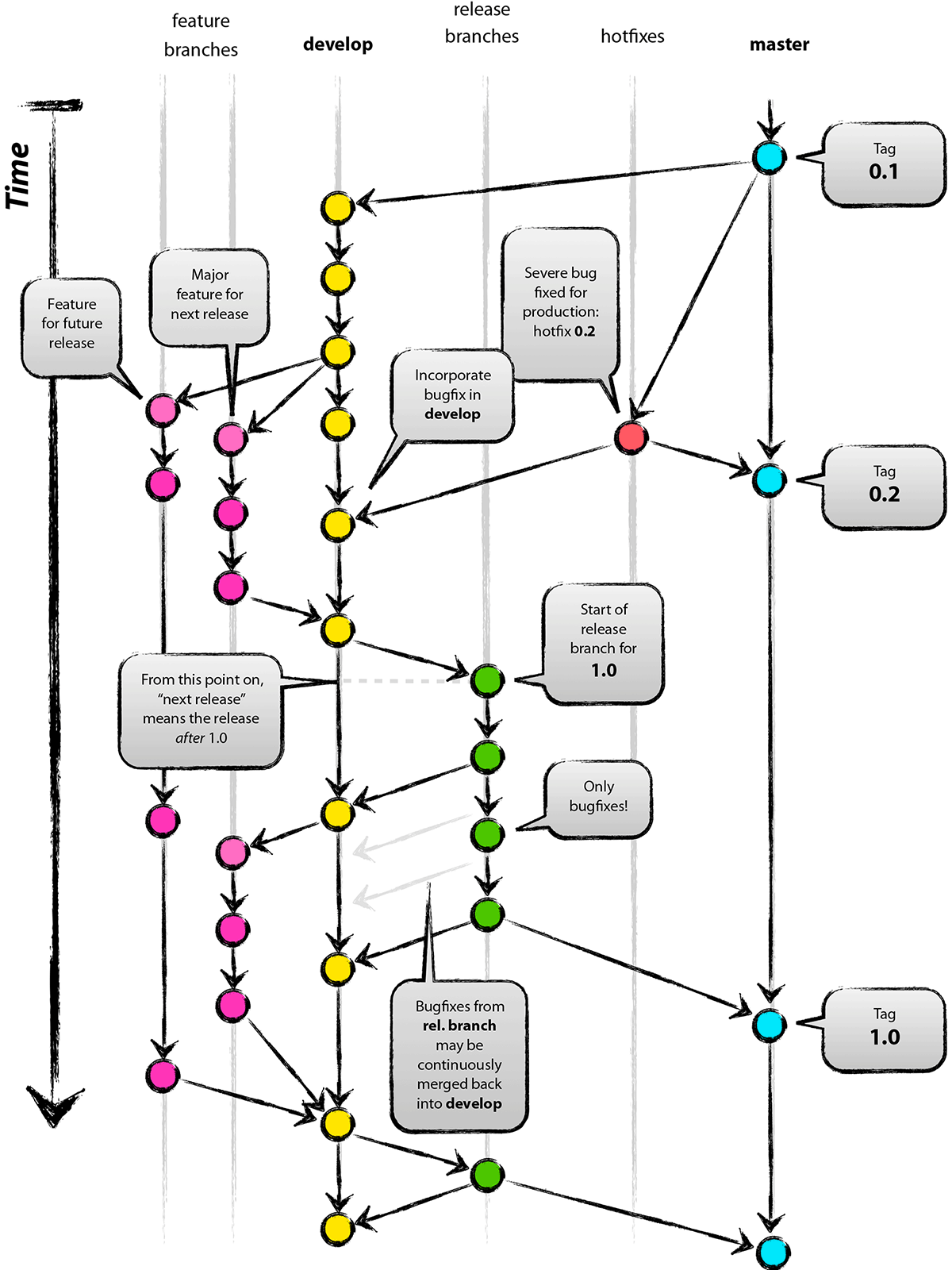
After your fork the bmm repository and create a branch for your new model/feature, you can follow a typical git workflow. As you make changes and add new files, you will want to:

2.1 Git commands

Add your changes to git, commit them and then push your changes to your forked repository. You can run these commands from any terminal, including the one built into your editor, with the project as the working directory

Add changed files to the staging area. It is best to add specific files rather than using git add * or git add ., which can accidentally stage unintended files (e.g., .env, large data files, or fitted model objects):

git add R/model_my_model.R inst/stan_chunks/my_model_funs.stan

Commit the changes to the local repository

git commit -m "A short message describing the changes you made"

Push the changes to your forked repository

git push

You can (and should) repeat this process as many times as you need to before submitting a pull request. This will allow you to make many small changes and test them before submitting a pull request. Ideally each commit should be a small, self-contained change that can be easily reviewed.

2.2 Pull requests

When you are ready you can open a pull request from your forked repository to the main bmm repository. You can do this from the github website. Make sure to select the Develop branch as the base branch and your feature branch as the compare branch. You should add a detailed description of your changes, including the motivation for the changes and any relevant context. You should also mention any issues that your pull request resolves.

2.3 AI-assisted contributions

AI assistance is welcome. The maintainers use it. This section is not a warning against it, but a statement of what we need from you so that a pull request written with help from a language model can be reviewed like any other.

You are the author of every line you submit. Concretely, that means three things. You can explain what each function does and why it is written the way it is. You have run it — a real fit on real or simulated data, not only the test suite. And you answer for it in review, including the parts you did not type yourself.

Say in the pull request body which parts were AI-assisted and how you verified them. This is not a disclaimer and it does not count against you. It tells the reviewer where to look hardest, which makes the review faster and better, and it is the difference between a reviewer trusting the rest of the diff and checking all of it twice.

What the review does with it. A human approves, and for a new model that human has installed your branch and fitted the model. The disclosure tells them where to read closely; it does not shift the work onto a tool.

2.3.1 What review will send back

AI-generated code in bmm fails in recognizable ways. These are the ones that come up most often, and they are all cheap to fix before you open the pull request rather than after:

  • Defensive validation sprinkled through internals. A model generated with help tends to acquire argument checks in .model_*(), in configure_model.*() and in every private helper. Validation belongs in the exported constructor, because that is the only place where the argument named in the message is the argument the user passed. See Chapter 6.
  • Base stop(), warning() and sprintf(). These are what a model trained on general R code reaches for. bmm uses stop2(), warning2(), stopif(), warnif() and glue::glue(), and the reasons are not stylistic: message2() respects options(bmm.silent) and stopif() interpolates in the caller’s frame.
  • Explicit return() on the last line, and %>% where the package uses |>.
  • Comments that restate the code. # construct the family above a custom_family() call is noise. A comment should record why a line is the way it is, especially when it looks removable and is not.
  • A parameter recovery script that simulates and fits with the same function. This is the one that matters most, because it produces a result that looks like evidence. If you generate data with your own r*() function and fit a likelihood built from your own d*() function, any error common to both cancels and recovery looks clean whether the model is right or wrong. Use an independent generator.

The last one is worth the extra sentence: a recovery study that cannot fail tells the reviewer nothing, and it is the artifact they will ask for first.