Distribution functions for the three-parameter mixture model (mixture3p)
Source:R/distributions.R
mixture3p_dist.RdDensity, distribution, and random generation functions for the
three-parameter mixture model with the location of mu, precision of
memory representations kappa, probability of a target response p_mem,
and probability of a non-target response p_nt.
Usage
dmixture3p(
  x,
  mu = c(0, 2, -1.5),
  kappa = 5,
  p_mem = 0.6,
  p_nt = 0.2,
  tau = 0,
  vp_nodes = 81L,
  log = FALSE
)

pmixture3p(q, mu = c(0, 2, -1.5), kappa = 5, p_mem = 0.6, p_nt = 0.2)

qmixture3p(p, mu = c(0, 2, -1.5), kappa = 5, p_mem = 0.6, p_nt = 0.2)

rmixture3p(n, mu = c(0, 2, -1.5), kappa = 5, p_mem = 0.6, p_nt = 0.2, tau = 0)
Arguments
- x
Vector of observed responses
- mu
Vector of locations. First value represents the location of the target item and any additional values indicate the location of non-target items.
- kappa
Vector of precision values. With
tau > 0this is the concentration of the average trial, whose Fisher informationJ(kappa)is the mean ofJ.- p_mem
Vector of probabilities of a target response. For a
mixture3p()fit these arethetaton its native scale (version"simple", seenative_parameters()) ormin(1, K / set_size) * ptarget(versions"slot"and"slot_averaging").- p_nt
Vector of probabilities of a non-target response, summed over the non-targets, which share it equally. For a
mixture3p()fit these arethetanton its native scale (version"simple") ormin(1, K / set_size) * (1 - ptarget)(capacity versions). Unlikeptarget,p_memandp_ntare not conditional on a response from memory.- tau
Vector of scales for trial-to-trial variability in precision. The Fisher information
Jof a memory representation is drawn fromgamma(mean = J(kappa), scale = tau).tau = 0, the default, is constant precision. Seemixture3p().- vp_nodes
Number of quadrature nodes used when
tau > 0; must be an odd number of at least 41. Seemixture2p(). The random generation function needs no nodes: it drawsJfrom its gamma distribution and then the response, which is exact.- log
Logical; if
TRUE, values are returned on the log scale. Pass it by name: in bmm 1.4 it was the sixth argument, which is nowtau. Until bmm 1.6.0 a logical value in that position is still read aslog, with a warning.- q
Vector of quantiles
- p
Vector of probability
- n
Number of observations to generate data for
Value
dmixture3p gives the density of the three-parameter mixture model,
pmixture3p gives the cumulative distribution function of the
three-parameter mixture model, qmixture3p gives the quantile function of
the three-parameter mixture model, and rmixture3p gives the random
generation function for the three-parameter mixture model.
References
Bays, P. M., Catalao, R. F. G., & Husain, M. (2009). The precision of visual working memory is set by allocation of a shared resource. Journal of Vision, 9(10), Article 7.
van den Berg, R., Shin, H., Chou, W.-C., George, R., & Ma, W. J. (2012). Variability in encoding precision accounts for visual short-term memory limitations. PNAS, 109(22), 8780-8785.
Examples
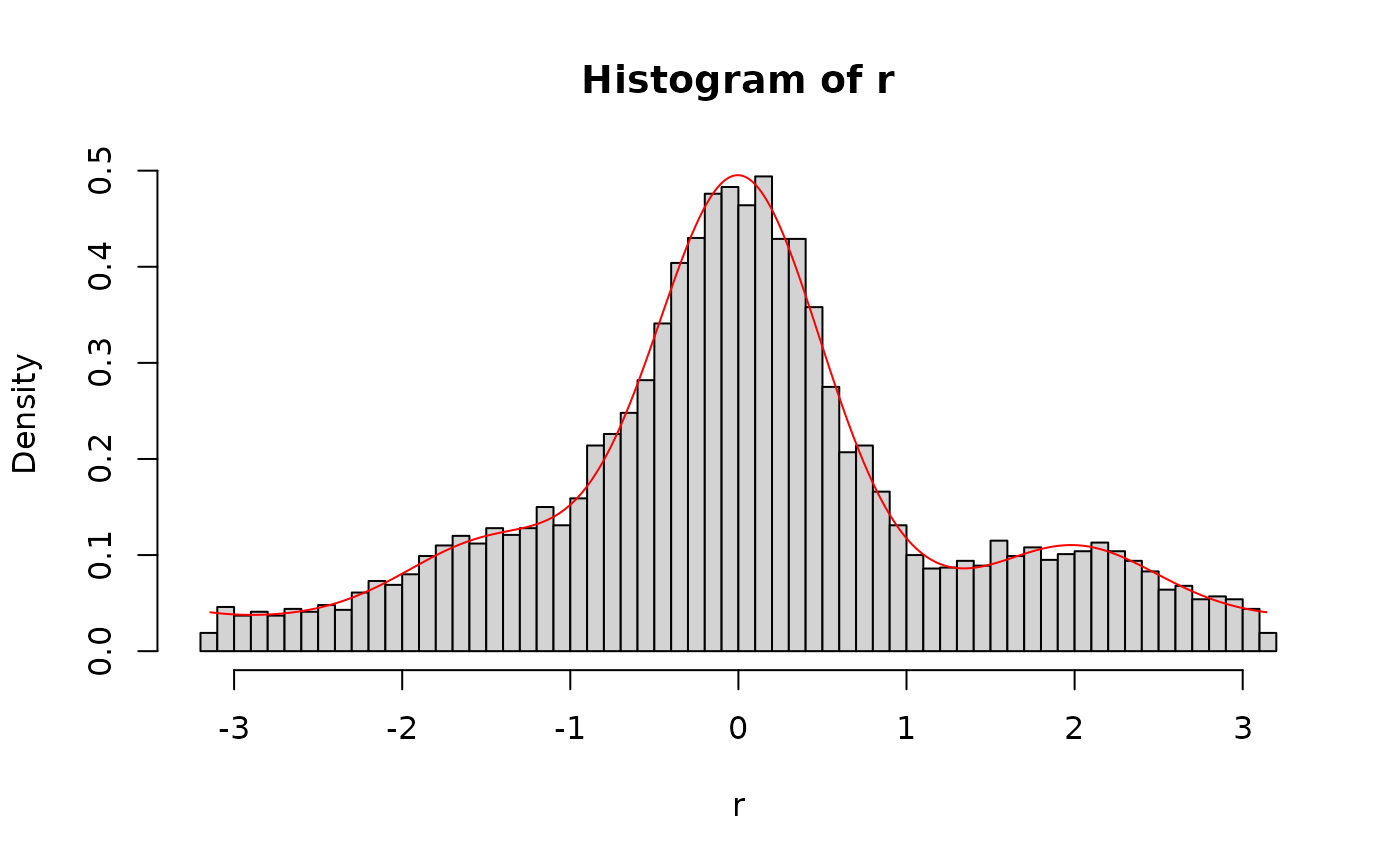
# generate random samples from the mixture3p model and overlay the density
r <- rmixture3p(10000, mu = c(0, 2, -1.5), kappa = 4, p_mem = 0.6, p_nt = 0.2)
x <- seq(-pi, pi, length.out = 10000)
d <- dmixture3p(x, mu = c(0, 2, -1.5), kappa = 4, p_mem = 0.6, p_nt = 0.2)
hist(r, breaks = 60, freq = FALSE)
lines(x, d, type = "l", col = "red")