
Handling RT Contamination in Evidence Accumulation Models
Gidon Frischkorn
Source:vignettes/articles/bmm_rt_contamination.Rmd
bmm_rt_contamination.Rmd
library(bmm)
library(dplyr)
library(ggplot2)
library(tidyr)
library(rtdists)

theme_set(theme_minimal(base_size = 12))
1 Introduction
Evidence accumulation models assume that all observed RTs arise from a single cognitive process. In practice, some trials reflect something else entirely: anticipatory responses, attention lapses, or accidental button presses. Even a few such contaminant trials can bias parameter estimates and distort model fit (Ratcliff and Tuerlinckx 2002).
The bmm package provides two functions for dealing with contamination, one for each type of model it supports:
| Model | Data type | Function | Role |
|---|---|---|---|
| EZDM | Aggregated stats | ezdm_summary_stats() |
Required during aggregation |
| DDM / csWald | Trial-level | flag_contaminant_rts() |
Optional preprocessing |
Both fit a mixture model via the EM algorithm, separating cognitive RTs from a uniform contaminant distribution (Ratcliff and Tuerlinckx 2002):
\[ f(RT) = (1 - \pi) \cdot f_{\text{cognitive}}(RT) + \pi \cdot f_{\text{uniform}}(RT) \]
where \(\pi\) is the contamination proportion. The cognitive component \(f_{\text{cognitive}}\) can be ex-Gaussian (default), log-normal, or inverse Gaussian. For background on the EZ diffusion model, see Wagenmakers et al. (2007) and Wagenmakers et al. (2008); for the full diffusion model, see Ratcliff and McKoon (2008).
2 Contamination handling for EZDM
EZDM estimates parameters from pre-computed moments of the reaction times (mean RT, variance) and proportion correct. Once data are aggregated, individual trials are gone, so contamination must be addressed during the aggregation step.
2.1 Method options
my_data |>
  group_by(subject, condition) |>
reframe(ezdm_summary_stats(rt, response, method = "mixture"))| Method | Description | Use when |
|---|---|---|
"simple" |
Standard mean/variance | Data is pre-cleaned |
"robust" |
Median + IQR/MAD-based variance (Wagenmakers et al. 2008) | Moderate contamination |
"mixture" |
EM mixture modeling (Ratcliff and Tuerlinckx 2002) | Default; provides contamination estimates |
2.2 Example: method comparison
As an example, we use data from Ratcliff and Rouder (1998), available in the rtdists package. First we show how the ezdm_summary_stats() method options work on a single participant’s data from the accuracy instruction condition in this data. The histogram below shows a long tail of slow RTs, which are likely contaminants:
data(rr98)

rr98_subset <- rr98 |>
  filter(id == "jf", instruction == "accuracy") |>
  mutate(response = ifelse(response == "dark", "upper", "lower")) |>
  select(rt, response, strength, correct)

ggplot(rr98_subset, aes(x = rt)) +
  geom_histogram(bins = 50, fill = "steelblue", alpha = 0.7) +
  labs(title = "RT Distribution (Ratcliff & Rouder, 1998)",
       subtitle = "One participant, accuracy condition",
       x = "Response Time (s)", y = "Count")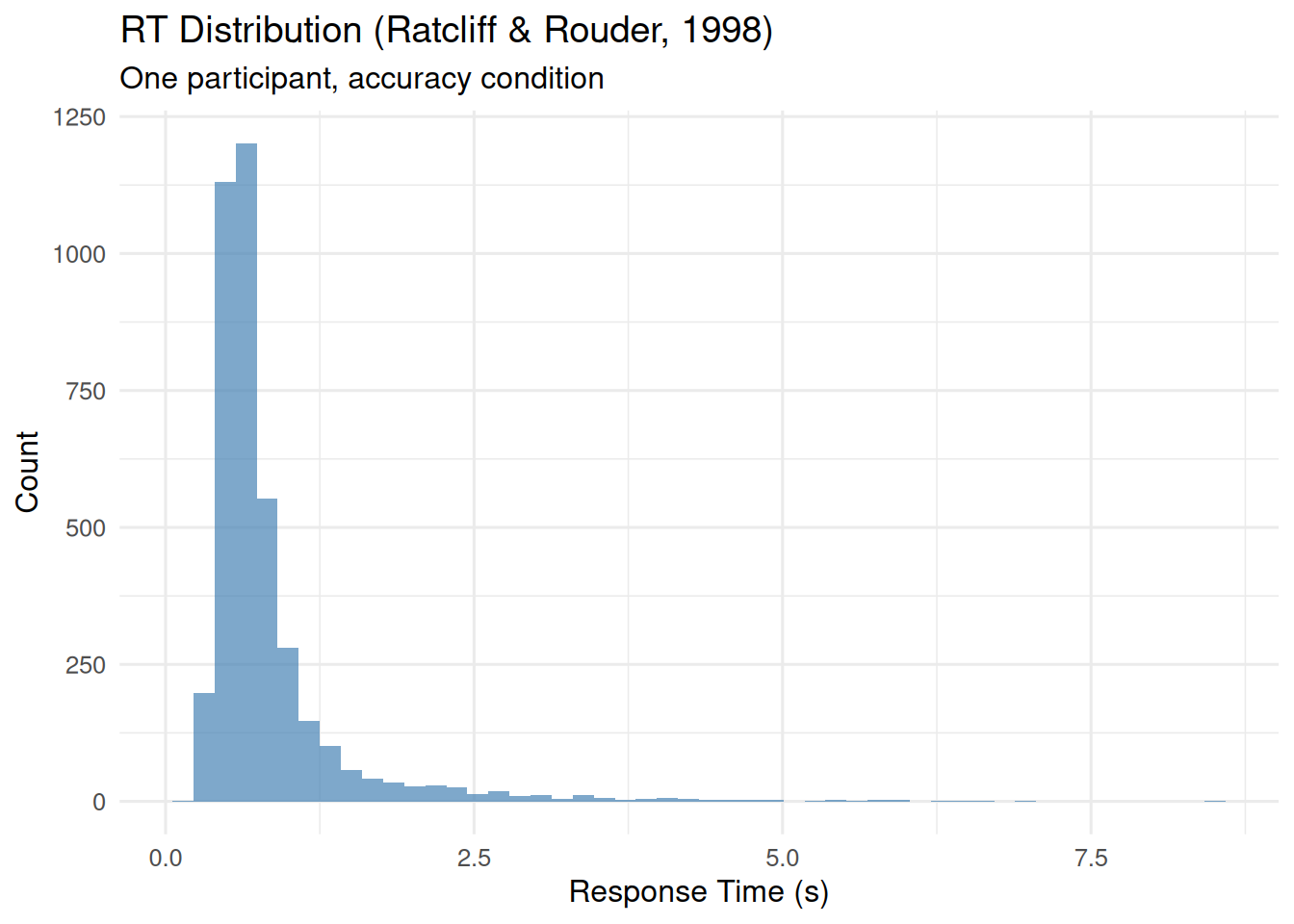
stats_simple <- ezdm_summary_stats(
  rr98_subset$rt, rr98_subset$response, method = "simple"
)
stats_robust <- ezdm_summary_stats(
  rr98_subset$rt, rr98_subset$response, method = "robust"
)
stats_mixture <- ezdm_summary_stats(
  rr98_subset$rt, rr98_subset$response,
  method = "mixture"
)

bind_rows(
  stats_simple |> mutate(method = "simple"),
  stats_robust |> mutate(method = "robust"),
  stats_mixture |> mutate(method = "mixture")
) |>
  mutate(accuracy = n_upper / n_trials) |>
  select(method, mean_rt, var_rt, accuracy, contaminant_prop)
#>       method   mean_rt     var_rt  accuracy contaminant_prop
#> ...1  simple 0.8231905 0.39684254 0.4752726               NA
#> ...2  robust 0.6440000 0.05804206 0.4752726               NA
#> mu   mixture 0.7500167 0.11366858 0.4745630       0.02797528
The mixture method also returns a contamination proportion estimate. The robust method is faster and makes no distributional assumptions, but does not quantify contamination.
2.3 3-parameter vs 4-parameter version
The version argument controls whether moments are computed jointly or separately by response boundary:
stats_3par <- ezdm_summary_stats(
  rr98_subset$rt, rr98_subset$response,
  method = "mixture", version = "3par"
)

stats_4par <- ezdm_summary_stats(
  rr98_subset$rt, rr98_subset$response,
  method = "mixture", version = "4par"
)

cat("3par - overall contamination:", round(stats_3par$contaminant_prop, 3), "\n")
#> 3par - overall contamination: 0.028
cat("4par - upper:", round(stats_4par$contaminant_prop_upper, 3),
    "  lower:", round(stats_4par$contaminant_prop_lower, 3), "\n")
#> 4par - upper: 0.032   lower: 0.024
The "4par" version is useful when contamination rates might differ between response boundaries and users are interested in estimating response bias for one response over the other. In most cases, "3par" is more stable and sufficient.
2.4 EZDM workflow
In a typical analysis, you would aggregate data for all subjects and conditions with ezdm_summary_stats(method = "mixture"), then fit the EZDM to those summary stats. The returned n_upper and n_trials already exclude the estimated contaminants, so they describe the same responses as the returned mean_rt and var_rt, and you can pass them to ezdm() unchanged.
# Step 1: Aggregate with contamination handling
ezdm_data <- raw_trial_data |>
  group_by(subject, condition) |>
  reframe(ezdm_summary_stats(rt, response, method = "mixture"))

# Step 2: Fit EZDM model
fit <- bmm(
  formula = bmf(drift ~ condition, bound ~ 1, ndt ~ 1),
  data = ezdm_data,
  model = ezdm(
    mean_rt = "mean_rt", var_rt = "var_rt",
    n_upper = "n_upper", n_trials = "n_trials"
  )
)
For the three-parameter version, splitting the estimated contaminants between the two boundaries requires an assumption about how accurate a contaminant response is. guess_rate carries that assumption and defaults to 0.5, the chance level of a two-choice task; set it to 0.25 for a 4AFC task, or to 0 if contaminants are never correct. The four-parameter version estimates contamination separately for each boundary and ignores guess_rate.
If a cell’s observed accuracy is higher than the estimated contamination and guess rate can produce — 95% correct is impossible when 15% of the trials were coin flips — the split cannot be trusted for that cell. The correction still runs, removing the estimated contaminants proportionally from both n_upper and n_trials and preserving observed accuracy up to rounding, but it warns. That usually means the guess rate does not match the task, or that the contaminant reaction times were not distinguishable enough from the cognitive ones for the EM to separate them. Both counts are rounded to integers, so the implied accuracy moves by at most one part in the corrected n_trials: at the default max_contaminant, a percent in a 200-trial cell and a fifth in a cell of ten trials, the default min_trials.
3 Contamination handling for DDM/csWald
DDM and csWald work with individual trials, so contamination handling is optional. flag_contaminant_rts() implements the same mixture modelling approach as ezdm_summary_stats(method = "mixture") and returns a contamination probability for each trial; You can use these probabilities in various ways, such as filtering, probabilistic flagging, or weighting trials.
3.1 Basic usage
flagged <- rr98_subset |>
  mutate(contam_prob = flag_contaminant_rts(rt))

head(flagged)
#>      rt response strength correct contam_prob
#> 1 0.801    upper        8    TRUE 0.002307907
#> 2 0.680    upper        7    TRUE 0.001599956
#> 3 0.694    lower       19    TRUE 0.001669001
#> 4 0.582    lower       21   FALSE 0.001215208
#> 5 0.925    upper       19   FALSE 0.003359717
#> 6 0.605    upper       10    TRUE 0.001286845
Diagnostics (convergence, parameters, log-likelihood) are available via attr(result, "diagnostics"):
probs <- flag_contaminant_rts(rr98_subset$rt)
attr(probs, "diagnostics")
#>   mixture_params contaminant_prop converged iterations    loglik n_trials
#> 1   0.420729....       0.02797528      TRUE         12 -926.5735     3943
#>   distribution     method
#> 1   exgaussian mixture_em
3.2 Grouped fitting
For obtaining the probability of contamination by subject, condition, or response, use dplyr::group_by():
rr98_grouped <- rr98 |>
  filter(id %in% c("jf", "kr")) |>
  mutate(response = ifelse(response == "dark", "upper", "lower"))

flagged_grouped <- rr98_grouped |>
  group_by(id, instruction) |>
  mutate(contam_prob = flag_contaminant_rts(rt))

head(flagged_grouped)
#> # A tibble: 6 × 13
#> # Groups:   id, instruction [1]
#>   id    session block trial instruction source strength response response_num
#>   <fct>   <int> <int> <int> <fct>       <fct>     <int> <chr>           <int>
#> 1 jf          2     1    21 accuracy    dark          8 upper               1
#> 2 jf          2     1    22 accuracy    dark          7 upper               1
#> 3 jf          2     1    23 accuracy    light        19 lower               2
#> 4 jf          2     1    24 accuracy    dark         21 lower               2
#> 5 jf          2     1    25 accuracy    light        19 upper               1
#> 6 jf          2     1    26 accuracy    dark         10 upper               1
#> # ℹ 4 more variables: correct <lgl>, rt <dbl>, outlier <lgl>, contam_prob <dbl>
3.3 Filtering strategies
The simplest approach is a hard threshold: remove trials where \(P(\text{contaminant} \mid RT) > 0.5\).
clean_data <- my_data |>
  mutate(contam_prob = flag_contaminant_rts(rt)) |>
  filter(contam_prob <= 0.5)
Alternatively, you can probabilistically sample removal decisions proportional to each trial’s contamination probability from a binomial distribution, which avoids the sharp cutoff:
3.4 DDM/csWald workflow
In a full analysis, you would flag contaminated trials first, then either filter or weight them before fitting the DDM or csWald. The example below shows a simple filtering workflow:
# Step 1: Flag contaminated trials
flagged_data <- raw_data |>
  group_by(subject, condition) |>
  mutate(contam_prob = flag_contaminant_rts(rt)) |>
  ungroup()

# Step 2: Filter
clean_data <- flagged_data |> filter(contam_prob < 0.5)

# Step 3: Fit model
fit <- bmm(
  formula = bmf(drift ~ condition, bound ~ 1, ndt ~ 1),
  data = clean_data,
  model = ddm(rt = "rt", response = "response")
)
3.5 Validating fast guesses
In 2AFC tasks, if fast contaminants are truly random guesses, their accuracy should be around 50%. The helper function validate_fast_guesses() checks this with a Bayesian Beta-Binomial test (Savage-Dickey Bayes Factor):
my_data$is_contaminant <- flag_contaminant_rts(my_data$rt) > 0.5

validation <- validate_fast_guesses(
  contam_flag = my_data$is_contaminant,
  rt_data = my_data$rt,
  response = my_data$response
)

validation$bf_01        # BF for guessing hypothesis
validation$bf_evidence  # Jeffreys scale category
validation$guess_in_hdi # Is 0.5 in 95% HDI?
This function can also be used with grouped data to check for differences in fast guess rates across conditions or subjects.
4 Case study: multi-subject analysis
The full Ratcliff and Rouder (1998) dataset has three participants in a brightness discrimination task under speed and accuracy instructions. We walk through both workflows on these data.
4.1 Data preparation
data(rr98)

case_study_data <- rr98 |>
  mutate(response = ifelse(response == "dark", "upper", "lower")) |>
  select(id, instruction, rt, response, correct, strength)

cat("Trials:", nrow(case_study_data),
    " Subjects:", n_distinct(case_study_data$id),
    " Instructions:", paste(unique(case_study_data$instruction), collapse = ", "), "\n")
#> Trials: 24358  Subjects: 3  Instructions: accuracy, speed
ggplot(case_study_data, aes(x = rt, fill = instruction)) +
  geom_histogram(bins = 50, alpha = 0.6, position = "identity") +
  scale_fill_manual(values = c("speed" = "coral", "accuracy" = "steelblue")) +
  labs(title = "RT Distributions by Instruction Condition",
       x = "Response Time (s)", y = "Count") +
  xlim(0, 3)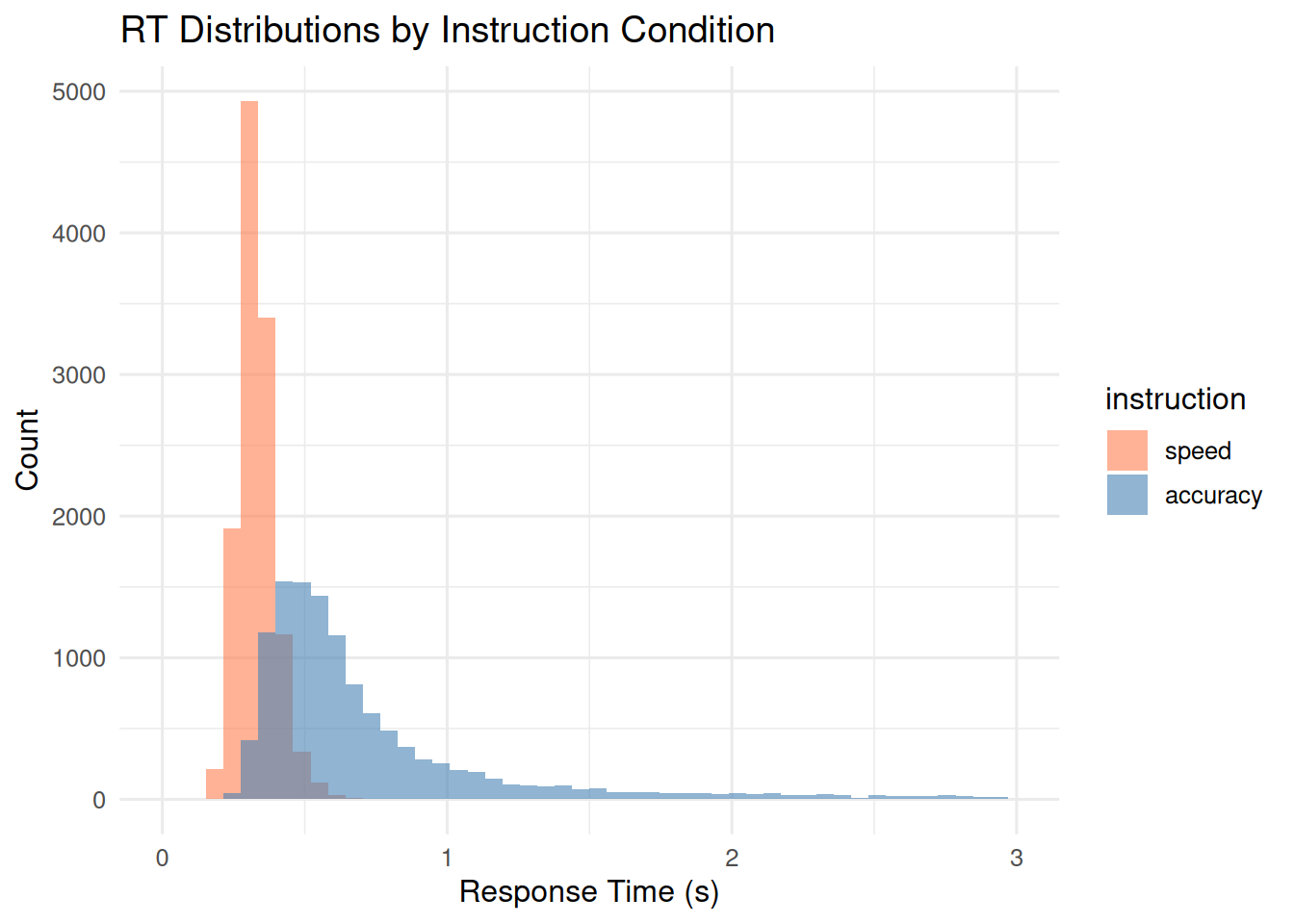
4.2 Workflow A: EZDM
ezdm_data <- case_study_data |>
  group_by(id, instruction) |>
  reframe(ezdm_summary_stats(
    rt, response,
    method = "mixture", version = "4par",
  ))

ezdm_data |>
  select(id, instruction, contaminant_prop_upper, contaminant_prop_lower)
#> # A tibble: 6 × 4
#>   id    instruction contaminant_prop_upper contaminant_prop_lower
#>   <fct> <fct>                        <dbl>                  <dbl>
#> 1 jf    speed                      0.00161                0.00145
#> 2 jf    accuracy                   0.0316                 0.0240
#> 3 kr    speed                      0.00241                0.00362
#> 4 kr    accuracy                   0.0147                 0.0284
#> 5 nh    speed                      0.00257                0.00155
#> 6 nh    accuracy                   0.0396                 0.0506
ezdm_simple <- case_study_data |>
  group_by(id, instruction) |>
  reframe(ezdm_summary_stats(rt, response, method = "simple"))

ezdm_mixture <- case_study_data |>
  group_by(id, instruction) |>
  reframe(ezdm_summary_stats(
    rt, response, method = "mixture",
  ))

bind_rows(
  ezdm_simple |> mutate(method = "simple"),
  ezdm_mixture |> mutate(method = "mixture")
) |>
  group_by(instruction, method) |>
  summarize(grand_mean_rt = mean(mean_rt), grand_var_rt = mean(var_rt),
            .groups = "drop")
#> # A tibble: 4 × 4
#>   instruction method  grand_mean_rt grand_var_rt
#>   <fct>       <chr>           <dbl>        <dbl>
#> 1 speed       mixture         0.331      0.00378
#> 2 speed       simple          0.332      0.00575
#> 3 accuracy    mixture         0.713      0.134
#> 4 accuracy    simple          0.793      0.463
4.3 Workflow B: DDM/csWald
flagged_data <- case_study_data |>
  group_by(id, instruction, response) |>
  mutate(contam_prob = flag_contaminant_rts(
    rt, contaminant_bound = c("min", "max")
  )) |>
  ungroup()
ggplot(flagged_data, aes(x = rt, y = contam_prob, color = instruction)) +
  geom_point(alpha = 0.1) +
  geom_hline(yintercept = 0.5, linetype = "dashed", color = "red") +
  scale_color_manual(values = c("speed" = "coral", "accuracy" = "steelblue")) +
  xlim(0, 3) +
  labs(title = "Contamination Probability vs. RT",
       x = "Response Time (s)", y = "P(Contaminated)")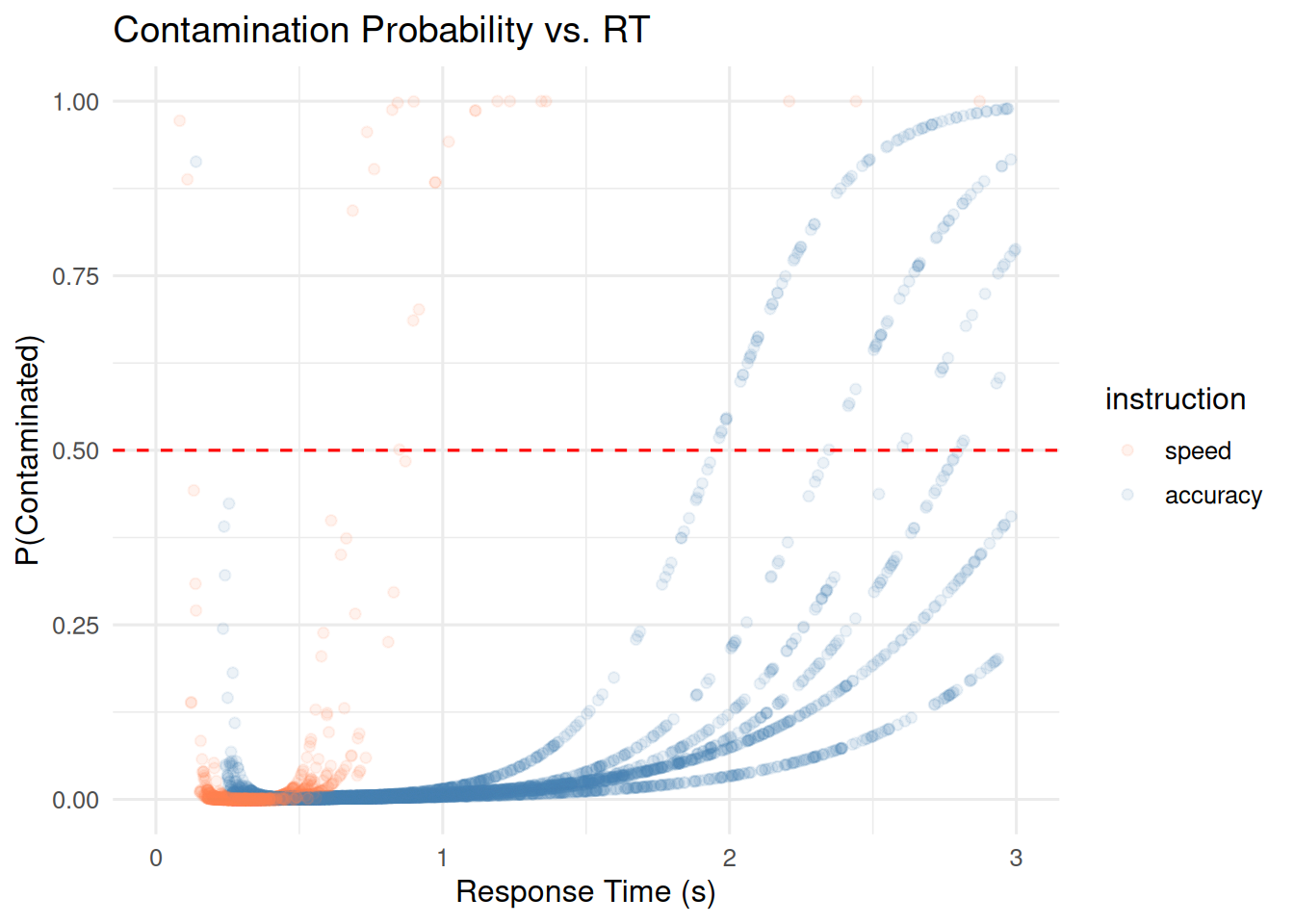
clean_data <- flagged_data |> filter(contam_prob < 0.5)

case_study_data |>
  group_by(instruction) |>
  summarize(original_n = n(), .groups = "drop") |>
  left_join(
    clean_data |>
      group_by(instruction) |>
      summarize(filtered_n = n(), .groups = "drop"),
    by = "instruction"
  ) |>
  mutate(removed_pct = round(100 * (original_n - filtered_n) / original_n, 1))
#> # A tibble: 2 × 4
#>   instruction original_n filtered_n removed_pct
#>   <fct>            <int>      <int>       <dbl>
#> 1 speed            12153      12130         0.2
#> 2 accuracy         12205      11876         2.7
Both workflows pick up on contamination differences between instruction conditions.
5 Practical guidance
Before applying these functions, filter out implausible RTs that clearly cannot reflect any cognitive process. For example, RTs below 100ms are too fast for a voluntary motor response, and in many experiments RTs exceeding 10s in a speeded task likely reflect disengagement rather than slow accumulation. Removing these extreme values before mixture modeling ensures the algorithm focuses on distinguishing genuine slow responses from moderate contaminants, rather than being distorted by impossible values.
Group by factors that affect the RT distribution (subject, condition), but keep at least 50 to 100 trials per group so the mixture model has enough data to work with.
The default data-driven bounds (c("min", "max")) adapt the uniform component to the observed RT range and work well in most cases. If you need fixed bounds for cross-study comparability, specify them explicitly (e.g., contaminant_bound = c(0.1, 3.0)). RTs outside the contaminant bounds receive a contamination probability of zero, so ensure that implausible RTs are filtered beforehand.
The ex-Gaussian distribution is a safe starting point. Try log-normal if you have heavy tails, or inverse Gaussian if you want a closer match to the Wiener process. See ?ezdm_summary_stats for details.
When the EM fails to converge, it usually means too few trials, bounds that do not fit the data well, or a contaminant proportion close to zero, where the EM converges slowly. In the last case the warning says that the EM stopped at maxit (default 500), and a larger maxit usually lets it converge. flag_contaminant_rts() then returns NA for every trial of the group, and attr(result, "diagnostics")$converged is FALSE. ezdm_summary_stats() has no such attribute. It warns and falls back to robust moments, and n_upper and n_trials stay the raw counts.
If estimated contamination rates exceed 20%, first check that RTs are in seconds, not milliseconds. Then verify your bounds. If the rates still seem high, the data may genuinely be noisy.
A 0.5 filtering threshold means you remove trials that are more likely contaminant than not. Raise it to 0.7 to keep more borderline trials, or lower it to 0.3 to filter more aggressively.